From a mineralogical perspective, ruby does not exist as an independent mineral species. It is the vivid red chromophore-bearing variety of corundum, an aluminium oxide ($\text{Al}_2\text{O}_3$). Within the corundum group, gemologists apply a binary classification:
- Ruby: Restricted exclusively to corundum whose dominant hue is red.
- Sapphire: Encompasses all other gem-quality corundum varieties. This includes blue corundum (classic sapphire) as well as the complete spectrum of fancy-colour sapphires (yellow, green, purple, orange, black, and colourless leucosapphire), alongside the pink-orange variety known as padparadscha.
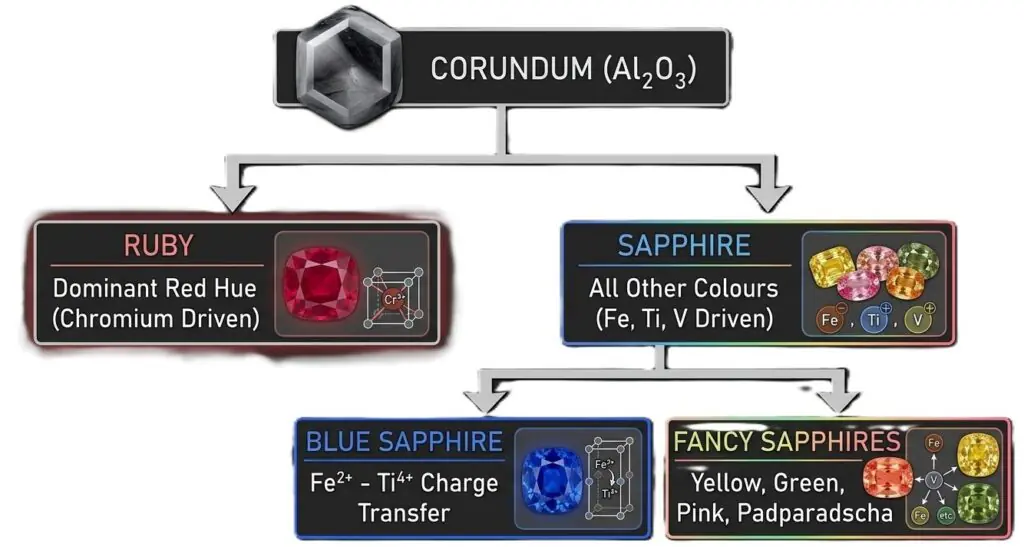
The boundary between ruby and pink sapphire remains one of the most contentious diagnostic challenges in gemological laboratories.
- Chemically, both gems owe their colouration to the substitution of aluminium by chromium ($\text{Cr}^{3+}$).
- The distinction is purely chromatic, hinging on colour saturation, tone, and dominant hue.
- Major grading bodies (such as the GIA, SSEF, and Gübelin) utilise master stones under standardised D65 daylight-equivalent illumination to judge whether a stone crosses the threshold from pink sapphire into ruby.
- If secondary modifier tones—such as purple or orange—predominate, or if the tone is too light and saturation too weak, the gem is classified as a fancy sapphire rather than a ruby, carrying significant commercial and per-carat valuation implications.
2. Crystal Chemistry & The Physics of Colour
Corundum crystallises in the trigonal crystal system (hexagonal scalenohedral class, space group $R\bar{3}c$). The atomic architecture consists of a nearly hexagonal close-packed array of oxygen ($\text{O}^{2-}$) anions, with two-thirds of the octahedral interstices occupied by aluminium ($\text{Al}^{3+}$) cations.
Because pure corundum contains no native transition elements capable of absorbing visible light, it is completely colourless (allochromatic).
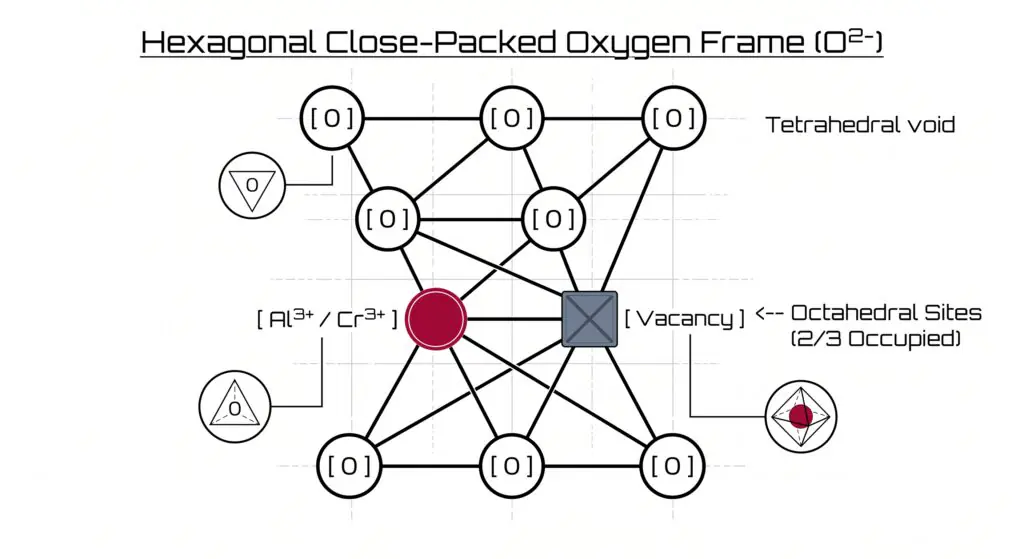
The Role of Trivalent Chromium ($\text{Cr}^{3+}$)
The transformation of colourless corundum into ruby occurs when trace quantities of chromium ($\text{Cr}^{3+}$) substitute isomorphously for $\text{Al}^{3+}$ in the rigid octahedral sites:
$$\text{Al}_2\text{O}_3 + x\text{Cr}^{3+} \longrightarrow (\text{Al}_{1-x}\text{Cr}_x)_2\text{O}_3$$
Because the ionic radius of $\text{Cr}^{3+}$ ($0.615\text{ \AA}$) is slightly larger than that of $\text{Al}^{3+}$ ($0.535\text{ \AA}$), the chromium ion experiences a compressed crystal field within the tightly bound corundum lattice.
- This octahedral ligand field splits the $3d$ electron orbitals of the chromium ion.
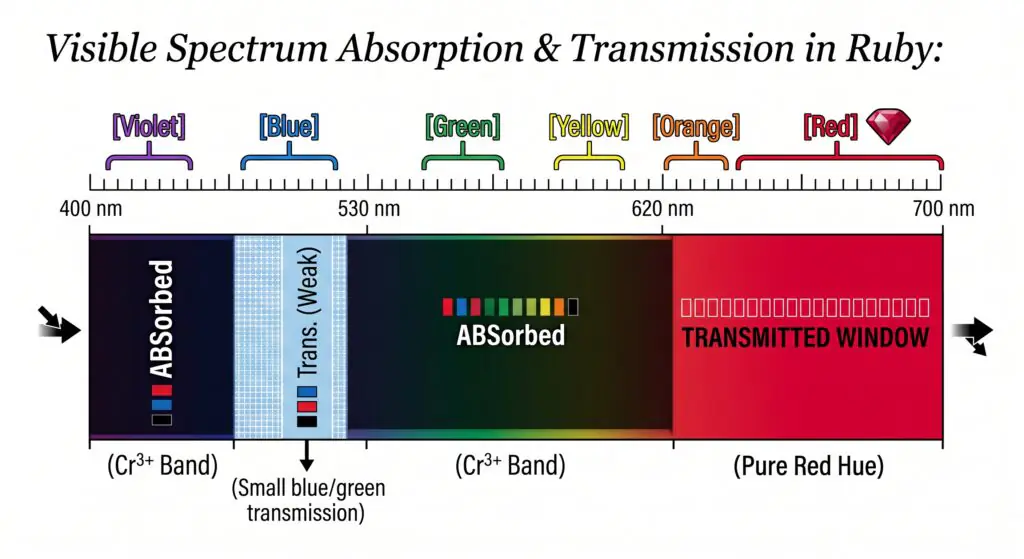
- The electronic transitions absorb light strongly across two broad visible bands: one in the violet region ($\sim 400\text{–}410\text{ nm}$) and one in the yellow-green region ($\sim 550\text{–}560\text{ nm}$).
- The unabsorbed wavelengths—predominantly the red transmission window ($\sim 600\text{–}700\text{ nm}$) and a narrow transmission window in the deep blue ($\sim 480\text{ nm}$)—pass through the crystal, imparting the characteristic red body colour.
UV Fluorescence vs. Iron Quenching
A critical gemological property linked to chromium is fluorescence:
- When excited by ultraviolet light (especially long-wave UV at $365\text{ nm}$), $\text{Cr}^{3+}$ ions absorb high-energy radiation and drop back down to the ground state via a radiative transition, emitting a brilliant crimson luminescence at the doublet $R$-lines ($692.8\text{ nm}$ and $694.3\text{ nm}$).
- In marble-hosted rubies (such as classic Burmese specimens from Mogok), the host geological environment is rich in aluminium and chromium but depleted in iron ($\text{Fe}$). In the absence of iron, this red fluorescence triggers under daylight conditions (which contains natural UV), creating the visual effect of an internal, self-luminous red glow.
- In basaltic or iron-rich metamorphic deposits (such as Thailand, Cambodia, and select East African localities), trace iron ($\text{Fe}^{3+}$) substitutes into the lattice alongside chromium. Iron acts as an energy quencher: non-radiative energy transfer occurs between neighbouring chromium and iron ions, neutralising the fluorescence and imparting a darker, brownish or brick-red undertone.
3. Optical Physics, Crystallography & Asterism
Crystallographic Properties
- Optic Character: Uniaxial negative ($\text{U}-$). The principal optic axis aligns with the crystallographic $c$-axis.
- Refractive Index (RI): $n_\omega = 1.768\text{–}1.778$, $n_\varepsilon = 1.760\text{–}1.770$ (birefringence $\delta = 0.008$).
- Pleochroism: Strong dichroism directly tied to crystallographic orientation:
- Ordinary ray ($\omega$): Purplish-red (vibrant, rich red).
- Extraordinary ray ($\varepsilon$): Orangey-red (paler, more yellow-shifted).
- Lapidary Consequence: Cutters orient the table facet perpendicular to the $c$-axis to maximise the pure purplish-red $\omega$-ray viewing face-up, while concealing the weaker orangey-red $\varepsilon$-ray.
- Fracture and Parting: Corundum has no true cleavage. However, structural polysynthetic twinning along the rhombohedron $\{10\bar{1}1\}$ or basal plane $\{0001\}$ produces planes of weakness termed parting, which can be mistaken for cleavage under mechanical stress.
Asterism & The Star Ruby
When corundum forms under specific thermal and geochemical conditions, titanium ($\text{Ti}^{4+}$) is held in solid solution at elevated temperatures. As the rock mass cools, the solubility of titanium plummets, causing titanium dioxide to unmix (exsolve) from the corundum host.
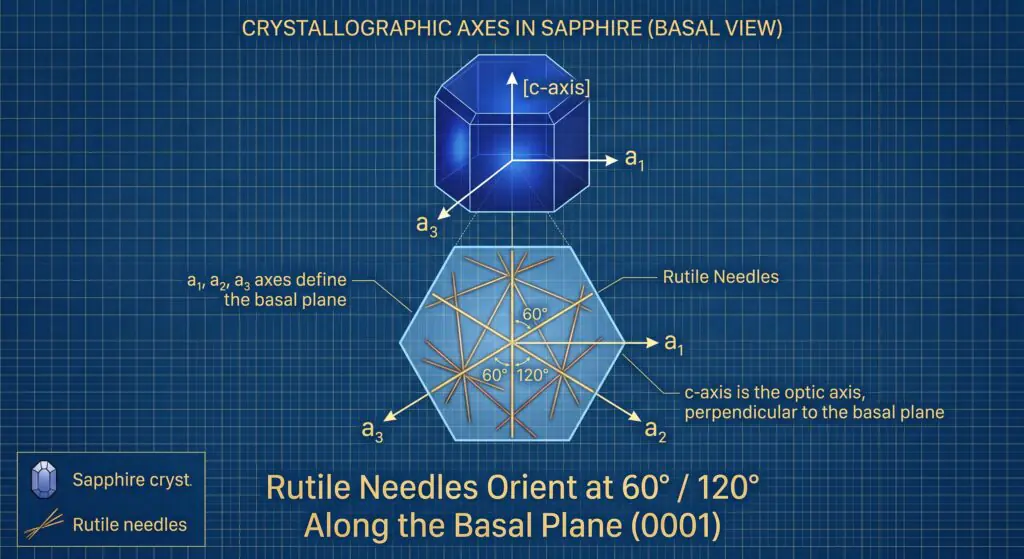
This exsolution manifests as microscopic, needle-like crystals of rutile ($\text{TiO}_2$), colloquially termed “silk”:
- These needles orient epitaxially along the three crystallographic directions of the basal plane $\{0001\}$, intersecting at angles of $60^\circ$ and $120^\circ$.
- When a specimen with sufficient silk density is fashioned en cabochon with a symmetrical dome and the base parallel to the $\{0001\}$ plane, incidental point-source light reflects off the cylindrical rutile needles.
- Each set of parallel needles produces a line of light perpendicular to their length. Three intersecting needle directions produce three light bands that cross at a central point, generating a six-rayed star (asterism).
- Twelve-rayed star rubies are exceptionally rare anomalies caused by the simultaneous exsolution of both rutile ($\text{TiO}_2$) and haematite-ilmenite ($\text{FeTiO}_3$) needles along alternate structural planes.
4. Microscopic Gemology: Diagnostic Inclusions (“Silk” and Internal Markers)
Microscopic examination remains the most reliable method for verifying natural origin, tracing geographic provenance, and distinguishing untreated rubies from synthetics and treated stones.
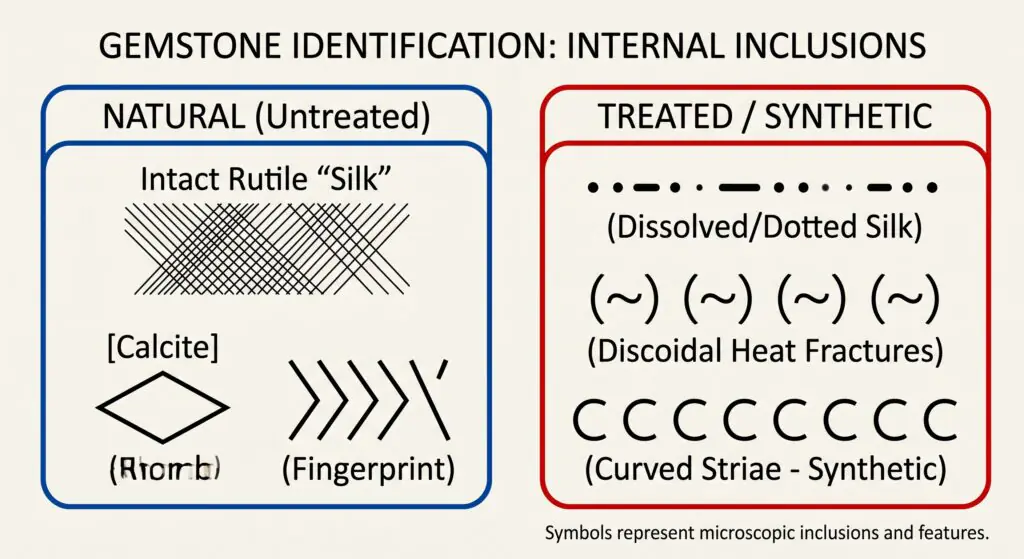
Primary Inclusions in Natural Ruby
- Rutile Silk ($\text{TiO}_2$): Long, slender, intersecting needles exhibiting interference colours. In unheated rubies, these needles remain sharply defined, continuous, and highly reflective.
- Partially Healed Fractures (“Fingerprints”): Fluid inclusions trapped during secondary healing phases of crystal growth. They form intricate web-like, labyrinthine networks consisting of two-phase (liquid-gas) or three-phase inclusions.
- Mineral Protogenetic & Syngenetic Crystals:
- Calcite and Dolomite rhombs: Hallmarks of marble-hosted rubies (Burma, Vietnam).
- Apatite: Rounded or subhedral hexagonal prisms common across African and Sri Lankan deposits.
- Zircon crystals: Often surrounded by dark pleochroic “haloes” caused by alpha-decay radiation damage.
- Bohemite / Diaspore needles: Intersecting intersecting lamellar twinning lines.
- Growth Zoning & Colour Banding: Angular, straight, hexagonal growth bands that parallel the prism and rhombohedral faces, directly reflecting shifts in chromium availability during crystal formation.
5. Synthetic vs. Natural Rubies: Synthesis Methods & Laboratory Identification
Because ruby was the first mineral synthesised in a laboratory, gemologists must distinguish between natural stones and sophisticated laboratory-grown alternatives:
| Synthesis Method | Growth Process & Environment | Key Diagnostic Inclusions | Confirmatory Advanced Testing |
| Verneuil (Flame Fusion) | Powdered $\text{Al}_2\text{O}_3$ and $\text{Cr}_2\text{O}_3$ are melted through an oxyhydrogen flame ($>2050^\circ\text{C}$) and deposited onto a rotating ceramic pedestal, forming a cylindrical boule. | • Curved striae (curved growth lines) • Gas bubbles (spherical or elongated “tadpole” shapes) • Fire marks / crackling on girdle | • UV-Vis-NIR: lacks natural iron absorption lines • SWUV: Chalky blue-violet to intense red surface luminescence |
| Flux Melt (Chatham, Kashan, Ramaura) | Oxides dissolve in an inorganic molten solvent (e.g., lithium molybdate, lead borate) at high temperatures ($\sim 1000\text{–}1300^\circ\text{C}$) and slowly precipitate onto seed crystals over months. | • Coarse, flux-filled fractures (“lace” or “dendritic” networks) • Metallic platinum flakes (from crucible walls) • Angular growth banding matching natural habits | • X-ray Fluorescence (EDXRF) / LA-ICP-MS: detects flux components ($\text{Mo}$, $\text{Pb}$, $\text{Bi}$, $\text{W}$, $\text{Pt}$) absent in natural rubies |
| Hydrothermal (Tairus / Biron) | Nutrients dissolve in an alkaline aqueous solution inside a high-pressure, high-temperature autoclave ($\sim 500\text{–}600^\circ\text{C}$, $1.5\text{–}3.0\text{ kbar}$), imitating geological conditions. | • “Chevron” or zigzag growth patterns • Parabolic or “nail-head” spicule inclusions (seed-mineral complexes) • Subtle cellular structure | • FTIR spectroscopy: diagnostic hydroxyl ($\text{OH}^-$) absorption features at specific wavenumbers ($3000\text{–}3600\text{ cm}^{-1}$) |
| Czochralski (Crystal Pulling) | Nutrients are melted in an induction-heated iridium crucible. A rotating seed crystal is dipped into the melt and pulled upward at a controlled rate to grow a large single crystal. | • Internal perfection; virtually free of inclusions • Faint gas bubbles (rare) • Faint curved growth lines visible under immersion | • Lack of natural trace elements (gallium, vanadium, titanium) via LA-ICP-MS; ultra-high chemical purity |
6. Gemological Treatments: Impact on Structure & Market Valuation
Treatments are designed to improve colour, eliminate undesirable secondary modifiers (e.g., blue or brown tones), and improve clarity by healing or filling internal fractures.
High-Temperature Heat Treatment (Thermal Enhancement)
- Mechanism: Specimens are heated in controlled atmospheres between $1200^\circ\text{C}$ and $1800^\circ\text{C}$. At these temperatures, fine rutile needles dissolve back into the corundum lattice.
- Gemological Evidence:
- Disrupted, dotted, or “melted” silk remnants.
- Discoidal stress fractures (haloes) surrounding mineral inclusions (such as zircons or apatites) due to differential thermal expansion between the host and inclusion.
- Altered, vitrified fluid fingerprints.
Flux Healing (Borax and Carbonates)
- Mechanism: Heat treatment performed with chemical fluxes (e.g., borax). The flux melts and enters surface-reaching fractures, partially dissolving the fissure walls and recrystallising synthetic corundum bridges that structurally seal the fissure.
- Identification: Refractive index boundary differences inside fissures, accompanied by trapped glassy flux droplets and residual flux strings.
Lead-Glass Fracture Filling
- Mechanism: Low-grade, heavily fissured corundum (often opaque) is acid-washed to clear iron-stain residues, then submerged in a high-lead bismuth glass melt at moderate temperatures ($900\text{–}1100^\circ\text{C}$). The high-refractive-index glass ($n \approx 1.76$) matches corundum, visually concealing extensive fractures and dramatically altering the stone’s apparent clarity.
- Identification:
- Flash Effect: Blue, orange, or violet iridescent optical flashes observed when tilting the stone under bright darkfield illumination.
- Large flattened gas bubbles trapped within the glass phase.
- Unstable under direct heat (jeweller’s torch) and susceptible to attack by household acids (e.g., lemon juice), which etch the lead-glass matrix and degrade the stone’s appearance.
       FLASH EFFECT IN GLASS-FILLED RUBY

           Incident Light Path
                   \
                    \
       ┌─────────────\──────────────────────┐
       │ Corundum     \                     │
       │               \ [Pb-Glass Interface]
       │   ═════════════\════════════════   │
       │                 \  Bright Blue /   │
       │                  \ Orange Flash    │
       │                   ▼                │
       └────────────────────────────────────┘
Market Valuation Implications
The commercial impact of treatments is substantial and non-linear:
[ Lead-Glass Filled ] <<<< [ Flux Healed ] < [ Standard Heat ] <<<< [ Natural / Untreated ]
   ($10 - $100/ct)            ($200 - $1k/ct)    ($1k - $10k/ct)         ($10k - $1M+/ct)
- Natural, Untreated Stones: Gemstones with laboratory confirmation (origin certificates from GIA, SSEF, or Gübelin) verifying no evidence of thermal enhancement command the highest market premiums, often realising five to ten times the value of an equivalent heated stone.
- Standard Heat: Widely accepted in fine jewellery, maintaining stable commercial liquidity.
- Lead-Glass Material: Categorised as a composite manufactured product rather than natural ruby; values fall to nominal per-carat levels, and major auction houses and international laboratories decline to issue standard grading reports for them.