Western gemology formally catalogued labradorite in Canada in 1770, but northern Europe was enchanted by the stone long before modern science gave it a name. Across the Baltic shield, the crags of southern Norway, and the ancient metamorphic rock of Karelia, these dark minerals flash with spectral fire—a phenomenon deeply woven into the lore of labradorite.
In the Norse cultural imagination, this interplay of stone and light mirrored Bifröst, the burning, three-stranded rainbow bridge joining Midgard to Asgard. Exploring the lore of labradorite shimmering reveals how early Scandinavian worldviews interpreted these minerals: not as inert silicates, but as physical fragments of mythic celestial architecture fallen to earth.
The Mythic Cosmology: Bifröst, Heimdall, and the Burning Bridge
To understand why iridescent stones became associated with the Norse cosmos, one must examine how the Prose Edda and Poetic Edda describe the bridge between the realms.
The Architecture of the Prismatic Bridge
In Snorri Sturluson’s Gylfaginning, the bridge Bifröst (variously translated from Old Norse as “the Shimmering Path,” “the Fleeting Way,” or “the Trembling Road”) is described as the greatest of all bridges, built with divine craft by the Æsir gods:
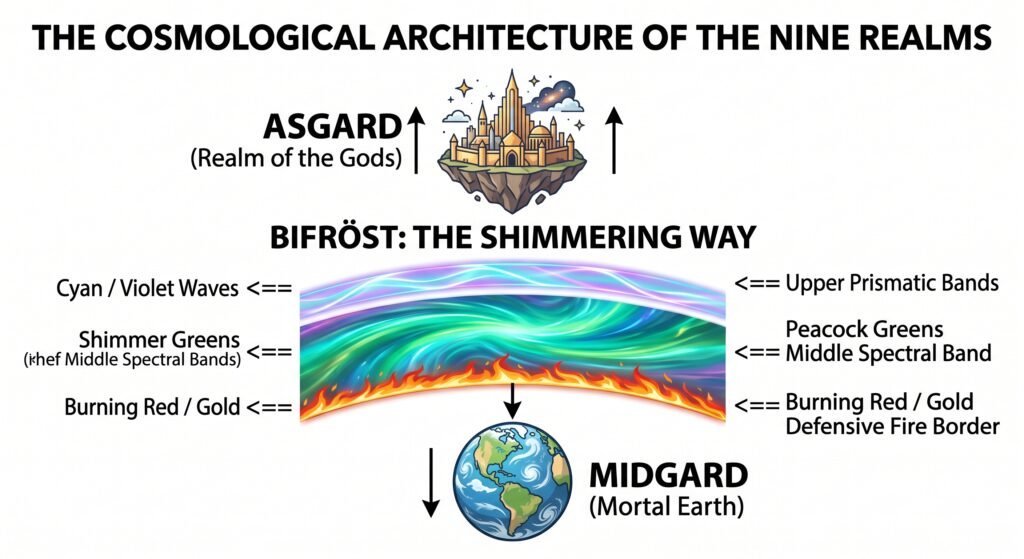
- Rather than a static rainbow, Bifröst was envisioned as a living, tremulous arch of woven light and fire.
- The lowest tier glowed with a fierce, burning red flame (roð), designed intentionally to prevent the Frost Giants (Hrimthursar) and Mountain Giants (Bergrisar) from scaling its heights into Asgard.
- The upper ribbons shimmered with brilliant emerald, azure, and gold—colours that shifted dynamically as the gods crossed daily to hold council beneath the world-tree, Yggdrasil, at the Well of Urd.
Heimdall and the Watchtower of Himinbjörg
Guarding the Asgardian foot of the bridge was Heimdall, the “white god” of vigilance. Stationed at his hall, Himinbjörg (“the Heaven-Cliffs”), Heimdall possessed senses so acute he could hear the grass growing from the earth, wool growing on sheep, and see hundreds of leagues across the nine realms through day and night.
Equipped with the horn Gjallarhorn, Heimdall stood as the eternal sentinel. Bifröst was destined to stand until Ragnarök (the twilight of the gods), when the sons of Muspelheim, led by Surtr the fire giant, would ride across it, causing the celestial structure to shatter into cosmic splinters under their immense collective weight.
Fallen Splinters: How Northern Folk Lore Linked Myth to Stone
In Scandinavian rural lore and modern northern neopagan traditions, iridescent feldspars—including Finnish spectrolite, Norwegian larvikite, and Scandinavian pegmatitic labradorite—have long been regarded as “fragments of the shattered bridge”.Talismans of the Safe Crossing
In northern folklore, traversing sea passages, glacial crevices, and vast tundra bogs was considered perilous travel between fragile worlds. Voyagers, scouts, and traders carried dark stones displaying hidden schiller as amulets of divine protection. Because Bifröst represented the only safe passage between distinct planes of reality, wearing a “Bifröst stone” was believed to:
- Impart Heimdall-like vigilance, sharpening the traveller’s peripheral sight and intuitive reflexes.
- Safeguard voyagers from maritime disorientation, dense fogs, and malevolent land-wights (Landvættir).
- Ensure an unbroken return home across treacherous terrain.
The Stone of the “Second Sight” (Framsýni)
In Old Norse culture, individuals who possessed prophetic insight or intuitive foreknowledge were said to have framsýni (“forward-sight”) or skyggn (“second sight”).
Just as the warrior or völva (seeress) had to read subtle signs in nature, shimmering feldspars were viewed as stones of spiritual discernment. Because the mineral’s iridescent flash remains entirely invisible until the stone is tilted to a precise angle against the light, northern mystics used it as a metaphor for the unseen world: proof that behind the mundane, sombre grey veneer of everyday life rests a hidden realm of divine light and magical consequence.
Scandinavian Geology: The Authentic Northern Feldspars
While Labrador, Canada, provided the scientific label for the species, Fennoscandia hosts some of the most geologically significant feldspar formations on Earth.
| Scandinavian Mineral | Geological Locality | Primary Host Rock | Optical Characteristics |
| Spectrolite | Ylämaa, South Karelia, Finland | Anorthosite inclusions in Wiborg Rapakivi Granite | Opaque black matrix with full-spectrum flash (red, orange, green, blue, purple) |
| Larvikite | Larvik & Oslo Rift, Vestfold, Norway | Monzonite / Augite Syenite pluton | Silvery-blue, steel-gray, and pearly adularescent-schiller patches |
| Peristerite / Oligoclase | Evje & Iveland pegmatites, Southern Norway | Granitic pegmatites in Precambrian gneiss | Translucent white to smoky matrix with delicate, sky-blue iridescence |
| Labradorite (Volhynite) | Zhytomyr & Baltic Shield margins (Ukraine/Russia) | Plutonic Gabbro-Anorthosites | Dark gray-black stone with broad, electric blue and peacock-cyan schiller |
Larvikite: Norway’s National Stone
In Norway, the most famous indigenous optical feldspar is larvikite, mined in the Vestfold region. While technically a monzonite rather than a calcic plagioclase, larvikite consists of inter grown ternary feldspars (anorthoclase and microperthite) that exhibit a metallic, silvery-blue schiller known as the “Schiller effect” or labradorescence.
Used extensively in historic regional architecture and grave markers, larvikite’s connection to Norse stone working is foundational: its dark, protective sheen was favoured for centuries as a building stone thought to ward off dark spirits and preserve quiet strength.
Ylämaa Spectrolite: The True Prismatic Rainbow
Directly east in Finland, the discovery of spectrolite during World War II provided the closest physical embodiment of the legendary Bifröst bridge known to mineralogy. Because Finnish spectrolite exhibits an opaque pitch-black base that supports warm reds, coppers, and yellows alongside deep blues and purples, it displays the complete, fiery spectrum described in the Eddic tales of the celestial archway.
Comparing Northern Traditions: Inuit Aurora vs. Norse Bifröst
The parallels between Arctic Indigenous lore and Scandinavian mythology demonstrate how distinct cultures observed the optical behaviour of local stones and drew remarkably similar mythic conclusions:
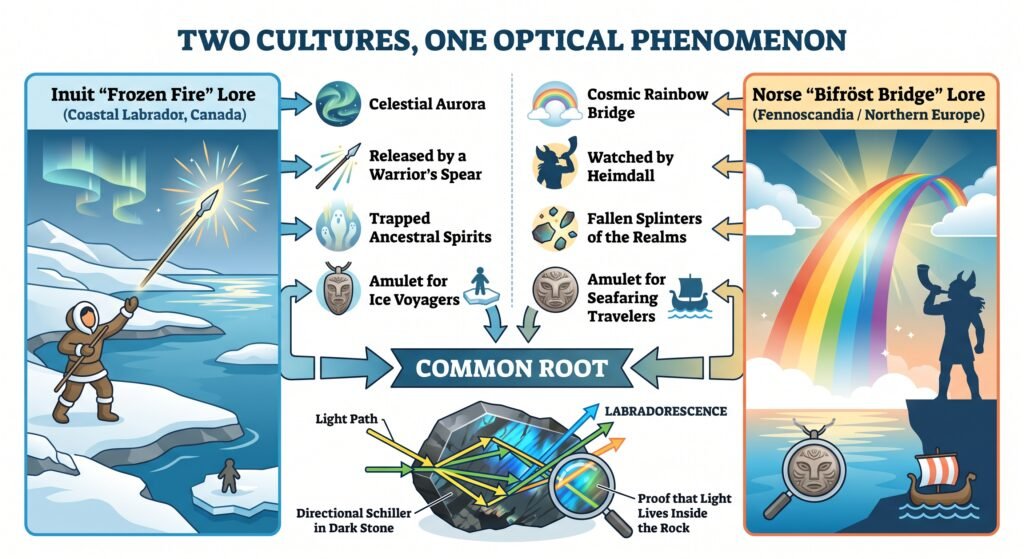
- The Inuit Tradition: Rooted in the subarctic sky and ancestral presence. Labradorite is “frozen fire”—the trapped embers of the northern lights that remain anchored in coastal cliffs to comfort and guide human hunters.
- The Norse Tradition: Rooted in cosmic architecture, travel, and vigilance. Shimmering stones are the threshold stones—fragments of the rainbow road that bridge the material struggles of Midgard with the spiritual sovereignty of the gods.
Both traditions recognise the same fundamental truth: that plagioclase feldspar possesses an uncanny, transformative optical nature that forces the observer to reconsider the boundary between matter and light.
Summary: Lore of Labradorite Shimmering Stones
In an age of atomic models and optical physics, it is easy to view labradorite strictly through the lens of Bøggild exsolution lamellae and wavelength interference. Yet delving into its mythic associations restores a sense of historical wonder.
To hold a piece of raw Finnish spectrolite or Norwegian optical feldspar is to connect with the ancient Scandinavian mind: a world where stone and sky were bound together, where watchful sentinels guarded the horizon, and where a flash of rainbow fire on a cold grey rock was proof that the gates to Asgard were never entirely closed.