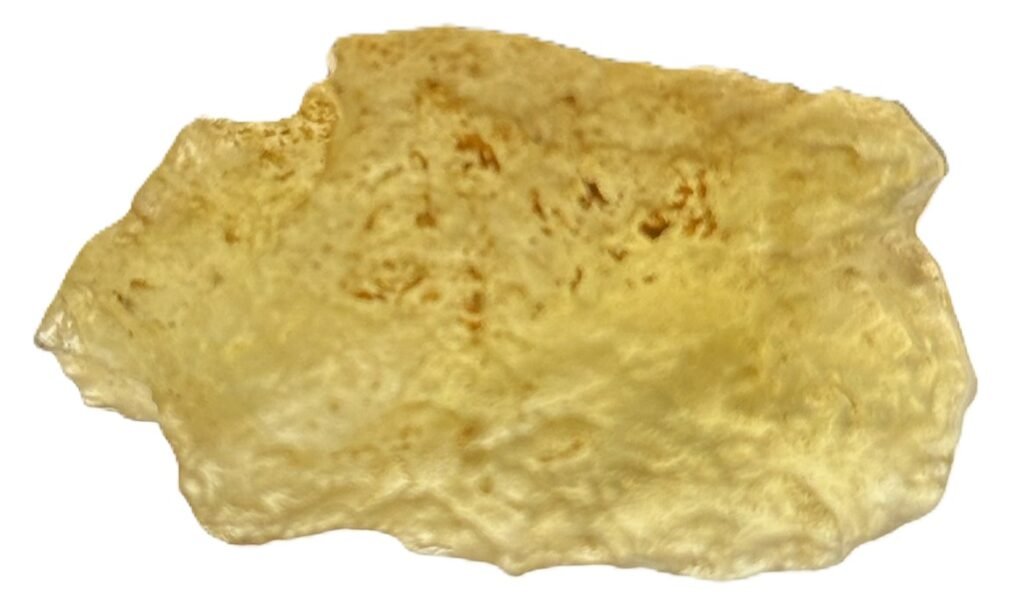
Spotting fake Libyan Desert Glass has become an essential skill for collectors and crystal buyers alike. Because genuine Libyan Desert Glass is a finite natural impactite—forged roughly 29 million years ago by a hypervelocity meteorite impact in the Great Sand Sea of Egypt and Libya—authentic specimens command high market prices. Unfortunately, that scarcity has flooded the online marketplace with convincing imitations made from acid-etched bottle glass, melted yellow slag, dyed quartz, and synthetic glass simulants.
Unlike terrestrial crystals with predictable crystal habits, natural Libyan Desert Glass is an amorphous silica glass composed of nearly 98% $\text{SiO}_2$. At first glance, a well-tumbled piece of pale yellow man-made glass can look remarkably similar to a genuine Saharan find. However, true desert glass bears unmistakable geological fingerprints left behind by extreme cosmic heat, rapid cooling, and millions of years of wind-blown sand abrasion—traits that factory-melted glass simply cannot replicate accurately.
In this practical buyer’s guide, we walk through 7 essential identification tests—from inspecting wind-eroded surface pitting and internal mineral inclusions under magnification to checking specific gravity, Mohs hardness, and UV fluorescence—so you can separate genuine Saharan impactite from fake Libyan Desert Glass with confidence.
Why Fake Libyan Desert Glass Floods the Market
Counterfeits typically fall into four categories, each targeting a different price tier:
- Acid-Etched Soda-Lime Bottle Glass: Melted yellow or amber cullet broken into chunks and tumbled in hydrofluoric acid or coarse grit to mimic desert sandblasting.
- Cast “Melt Glass” Slag: Mass-produced studio glass poured into textured moulds to imitate natural wind-sculpted ridges and flow lines (a technique long used to fake Moldavite).
- Heat-Treated Amethyst (“Baked Citrine”) or Yellow Quartz: Sold as “faceted Libyan Desert Glass” to jewellery buyers unfamiliar with refractive index and density differences.
- Yellow Copal or Amber: Occasionally mislabelled or sold as lightweight raw specimens, easily exposed by thermal and specific gravity tests.
7 Gemmological Tests to Authenticate Libyan Desert Glass
No single visual check is infallible on its own. Combining non-destructive optical, hydrostatic, and microscopic tests provides conclusive verification without damaging the specimen.
| Diagnostic Property | Genuine Libyan Desert Glass | Manufactured Glass Fake | Citrine / Yellow Quartz |
| Refractive Index (RI) | 1.460 – 1.465 (Isotropic) | 1.500 – 1.540+ (Isotropic) | 1.544 – 1.553 (Anisotropic / DR) |
| Specific Gravity (SG) | 2.20 – 2.21 g/cm³ | 2.45 – 2.60+ g/cm³ (up to 3.2 if leaded) | 2.65 g/cm³ |
| Internal Inclusions | Stretched bubbles, lechatelierite swirls, white spherical cristobalite | Uniformly round stationary bubbles, dye concentrations | Natural mineral veils, colour zoning, zero gas bubbles |
| Surface Texture | Frosted ventifact pitting, natural sandblasted patina, sharp conchoidal chips | Uniform acid-etched matte coat, mould seams, or fire-polished gloss | Crystalline growth striations or polished facets |
| Mohs Hardness | 5.5 – 6.5 | 5.0 – 5.5 | 7.0 |
The Refractive Index (RI) Test (Definitive Optical Benchmark)
Because Libyan Desert Glass consists of nearly pure amorphous silica (~98% $\text{SiO}_2$), its refractive index sits remarkably low compared to commercial glass containing sodium, calcium, or lead oxides.
- How to Test: Place a flat polished facet or smooth natural surface onto a standard gemmological refractometer using RI contact fluid ($n = 1.79$).
- Genuine Result: A single shadow edge reading sharply between 1.460 and 1.465, with no birefringence blink when rotating the polarising filter (confirming an isotropic, non-crystalline structure).
- Fake Result: Standard soda-lime glass reads 1.51–1.52; borosilicate reads ~1.47–1.49; leaded crystal reads 1.54–1.70; and citrine quartz shows a double-refraction (anisotropic) reading of 1.544–1.553.
Specific Gravity (Hydrostatic Weight Test)
Pure silica glass is substantially less dense than commercial glass or crystalline quartz. Even without laboratory equipment, experienced collectors notice that genuine LDG feels surprisingly lightweight in the palm (“low heft”) for its physical volume.
- How to Test: Weigh the dry specimen on a precision carat/gram scale ($W_{\text{air}}$), then suspend it fully submerged in distilled water at room temperature ($W_{\text{water}}$) using a fine wire cradle:$$\text{SG} = \frac{W_{\text{air}}}{W_{\text{air}} – W_{\text{water}}}$$
- Genuine Result: 2.20 to 2.21 g/cm³ (occasionally up to 2.24 g/cm³ in specimens rich in dark meteoritic or iron-bearing schlieren).
- Fake Result: Soda-lime glass measures 2.48–2.55 g/cm³, citrine measures 2.65 g/cm³, and amber floats or sinks slowly at 1.05–1.10 g/cm³.
Magnified Inclusion Inspection (10x Loupe & Darkfield Microscope)
Transmitted backlighting through a 10x triplet loupe or gemmological microscope reveals the violent thermal history of an impactite versus the calm annealing of a glassworks furnace.
- Look for High-Temperature Impact Markers:
- Elongated, Oriented Gas Bubbles: Tiny micro-bubbles stretched along fluid flow lines rather than sitting as large, perfectly spherical stationary pockets.
- Lechatelierite & Schlieren Swirls: Wavy, thread-like internal ribbons of pure melted silica and dark brown-to-smoky meteoritic vapour streaks.
- Cristobalite Spherulites: Tiny white, opaque, snowflake-like spherical clusters formed when silica devitrified at temperatures above 1,470°C. (Note: novices often mistake white cristobalite spheres for trapped desert sand grains).
- Red Flags: Large, crisp, perfectly round air bubbles evenly distributed throughout the stone, or swirls of unmixed coloured dye pooling near surface pits.
Surface Topography & Ventifact Erosion Check
Raw Libyan Desert Glass spent nearly 29 million years being sculpted by wind-driven quartz sand across the Eastern Sahara.
- Genuine Ventifact Skin: Natural exteriors display irregular, directional wind-abraded grooves, shallow scalloped depressions, and a soft, satiny “frosted” patina where the surface micro-pitting scatters light. Where ancient or modern impacts chipped the stone, fresh fractures show razor-sharp conchoidal (shell-like) ripples with a bright vitreous lustre contrasting against the matte weathered skin.
- Artificial Acid-Etching & Mould Marks: Fakes treated with acid show a uniform, chalky white or overly velvety matte frost across every crevice equally—lacking directional wind wear. Cast fakes frequently betray faint mould seams, rounded melted-looking edges, or unnatural glossy “fire-polished” ridges.
Colour Spectrum & Lighting Behaviour
Authentic Libyan Desert Glass exhibits subtle, organic colour gradients dictated by trace iron, titanium, and meteoritic elements:
- Genuine Palette: Ranges from pale champagne, milky ivory-cream, and straw yellow to warm honey-gold and olive-brown. Many specimens appear slightly muted or hazy in reflected light, then glow vibrantly when backlit.
- Fake Palette: Overly saturated “neon lemon,” uniform canary yellow, bright emerald green (sold as “green LDG”), or vivid orange tones are hallmarks of modern coloured glass.
Polariscope Check (Glass vs. Crystalline Quartz)
If you are evaluating a faceted gemstone or clear cabochon sold as Libyan Desert Glass, a basic gemmological polariscope separates amorphous glass from crystalline quartz in seconds.
- Genuine Result: Remains dark throughout a full 360-degree rotation—or displays vague, shadowy anomalous double refraction (ADR) bands caused by internal cooling strain.
- Fake Result (Citrine/Quartz): Blinks brightly from light to dark four times per full rotation (anisotropic extinction) and reveals a classic bull’s-eye optic interference figure when viewed with a condensing lens.
Why You Should Avoid Destructive “Home Tests”
Online guides frequently recommend scratching stones with steel files, heating needles, or applying acids. Never perform destructive tests on suspected Libyan Desert Glass:
- Mohs Hardness Overlap: Both genuine LDG (Mohs 5.5–6.5) and commercial soda-lime glass (Mohs ~5.5) are scratched by quartz (Mohs 7) and hardened steel. A scratch test permanently scars a genuine collector specimen while failing to separate natural silica glass from manufactured glass.
- Thermal Shock Risk: Heating LDG with a flame or hot needle can trigger instant internal stress fractures along lechatelierite flow bands.
Quick Buying Checklist & Provenance Red Flags
Before purchasing raw specimens or jewellery, verify the listing against these five commercial benchmarks:
- Price Per Gram Reality Check: Because export from Egypt is restricted and legacy stock is finite, genuine raw LDG typically retails between £1.50 and £6.00+ per gram (and considerably higher for transparent gem-grade or cristobalite-included pieces). Bulk bags sold at pennies per gram are guaranteed fakes.
- Geographic Accuracy: Authentic material originates exclusively from the Great Sand Sea (Western Desert, Egypt / eastern Libya border). Listings claiming “Moroccan,” “Chinese,” or “Tibetan” Libyan Desert Glass are mislabelled.
- Individual Specimen Photography: Reputable dealers photograph individual specimens or exact numbered parcels rather than using a single stock photo for hundreds of identical-looking chunks.
- Inclusions Disclosed: Trustworthy sellers highlight natural imperfections—such as milky bubble clouds, dark schlieren streaks, or white cristobalite spots—rather than marketing “flawless, crystal-clear” pieces at bargain prices.
- Independent Lab Certification for High-Value Gems: For large faceted stones or museum-grade specimens, request documentation from an accredited gemmological laboratory (such as GIA, Gem-A, or a recognised meteoritical specialist) confirming refractive index, specific gravity, and natural impactite origin.
- Buy from long term established specialist retailers like ourselves
These are my personally selected and curated Libyan Desert Glass products