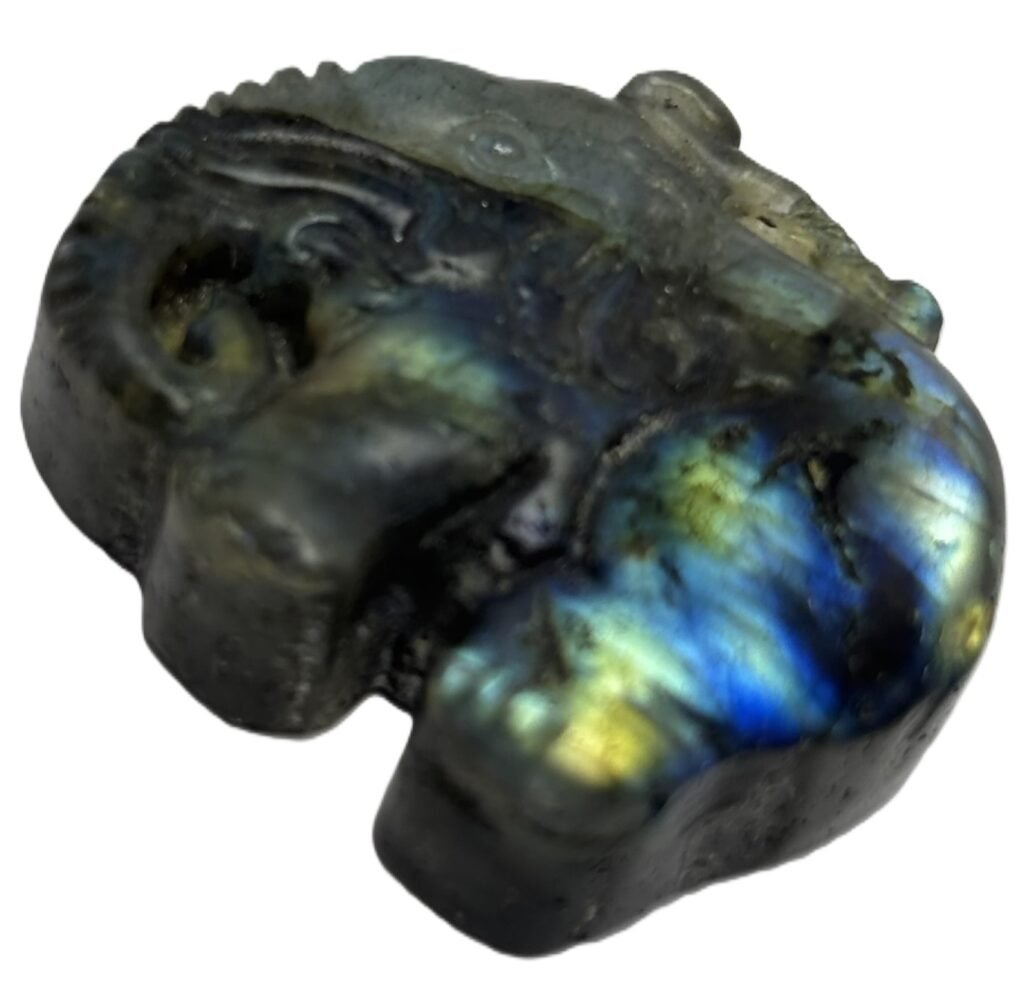
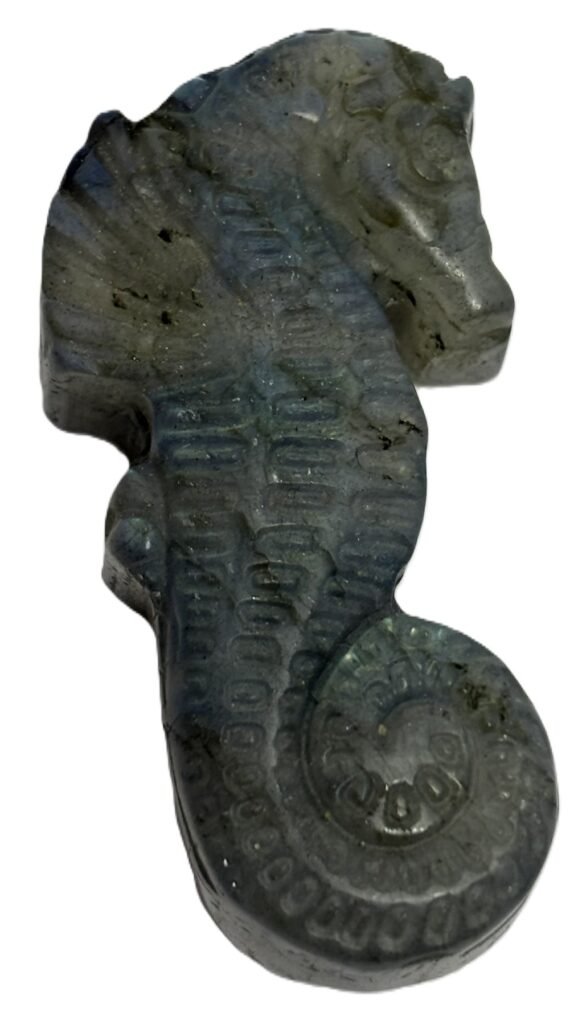
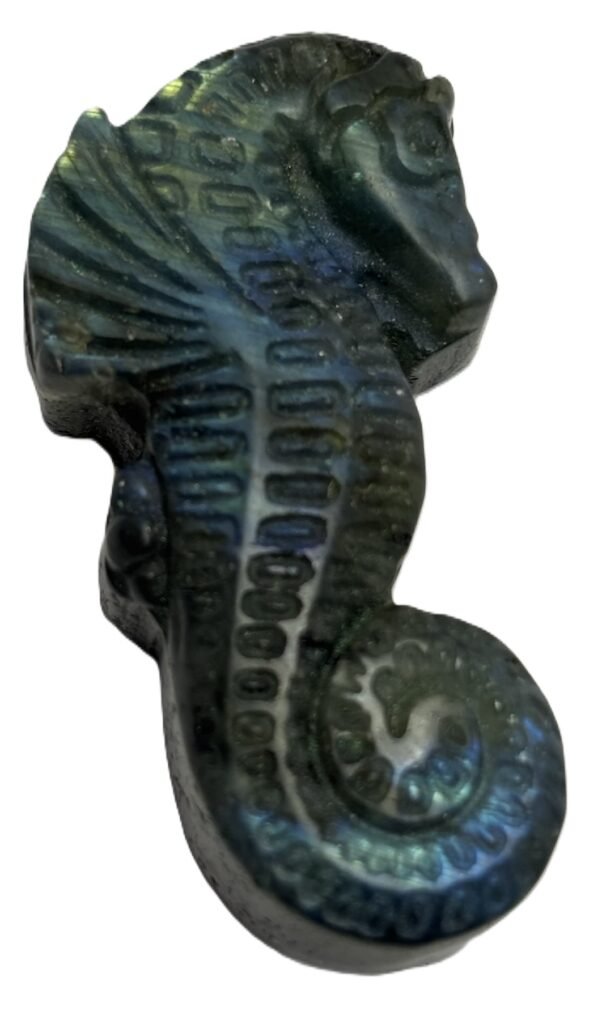
At first glance, holding a polished specimen of iridescent feldspar feels like capturing the Northern Lights in solid stone. Yet among lapidaries, gemologists, and discerning collectors, few distinctions spark as much curiosity and debate as Spectrolite vs Labradorite. While both belong to the plagioclase feldspar group and owe their hypnotic optical display to sub-microscopic crystal lamellae, they are far from interchangeable. To treat them as simple trade synonyms is to miss the unique crystallographic and regional story that elevates one from a beloved staple into one of the world’s most prized collector gems.
The fundamental separation begins deep underground. Standard labradorite is mined abundantly across deposits in Madagascar, Canada, Russia, and Australia, typically presenting a pale to translucent grey matrix that flashes with familiar, soothing blues and greens. Authentic spectrolite, discovered by chance during the construction of Finland’s Salpa Line fortifications in World War II, is a strictly defined, high-grade variety sourced exclusively from Ylämaa in South Karelia. Set against a dense, near-opaque black host rock, spectrolite produces an extraordinarily vivid optical display that spans the entire visible spectrum—igniting in rare, fiery reds, warm oranges, vibrant golds, and deep violets alongside the classic cool tones.
Mineralogically speaking, all spectrolite is labradorite, but not all labradorite is spectrolite.
The Definitive Distinction: Origin, Trademark, and History
To understand the difference, one must trace the mineral back to the borderlands of Finland during the Second World War.
- The Wartime Discovery (1940): While digging anti tank trench fortifications along the Salpa Line in Ylämaa, South Karelia, Finnish soldiers unearthed massive boulders of a dark, crystalline rock that glittered with vivid spectral hues under the sun.
- The Geological Naming: Finnish geologist Aarne Laitakari (then Director of the Geological Survey of Finland) analysed the specimens. Captivated by the fact that the stone displayed the entire visible spectrum—rather than just the cold blues and greens typical of Canadian material—he coined the term spectrolite.
- Trademark and Provenance: In the decades following the war, mining commenced around Ylämaa. The name Spectrolite was formally registered as a trade name to designate gem-grade labradorite originating specifically from this region. While the term is occasionally used descriptively in international mineral circles to describe stones showing full-spectrum flash, Finnish purists and reputable gemological institutions restrict the moniker strictly to Finnish material.
By contrast, commercial labradorite has been known since 1770, originally documented on Paul’s Island in Labrador, Canada, and today extracted by the metric ton primarily in Madagascar, India, Russia, and Ukraine.
Geological & Petrological Differences
Both stones belong to the plagioclase feldspar solid-solution series, falling squarely within the intermediate calcium-to-sodium range ($\text{An}_{50}–\text{An}_{70}$). However, the conditions under which they formed produced fundamental petrological contrasts.
| Feature | Standard Commercial Labradorite | Finnish Spectrolite |
| Primary Host Rock | Anorthosites, Gabbros, Basalt flows | Anorthositic megacrysts in Wiborg Rapakivi Granite batholith |
| Typical Matrix Colour | Translucent smoky grey, charcoal, or greyish-white | Dense, completely opaque pitch-black to velvet dark-brown |
| Exsolution Mechanism | Standard Bøggild intergrowth | Ultra-dense, uniform Bøggild exsolution lamellae |
| Colour Wavelengths Displayed | Narrow: Blues ($450\text{ nm}$), cyans, and yellow-greens ($500–530\text{ nm}$) | Broad: Reds ($650–700\text{ nm}$), oranges, violets, and magentas alongside blues/greens |
| Base Transparency | Translucent to semi-opaque (transmits back-light) | Opaque (blocks light transmission entirely) |
| Inclusions | Fine ilmenite needles, minor magnetite, fluid inclusions | High density of micro-crystalline ilmenite, magnetite, and iron oxides |
The Petrology of the Finnish Deposit
Spectrolite owes its black base to the unique geological setting of the Wiborg rapakivi granite massif. During the Mesoproterozoic era (approximately 1.6 billion years ago), plagioclase crystals crystallised inside slow-cooling plutonic chambers.
As the magma cooled, microscopic iron-titanium oxides (primarily ilmenite and magnetite) precipitated abundantly throughout the feldspar lattice. This natural “black backing” acts like the dark backing of a black opal, absorbing ambient scatter and providing high contrast that makes interference colours appear luminous and saturated.
Optical Physics: Schiller vs. Full-Spectrum Flash
The physics governing both stones relies on Bøggild exsolution: during slow plutonic cooling, the feldspar separates into alternating microscopic plates of calcium-rich and sodium-rich plagioclase. When light penetrates the stone, it reflects off these sub-microscopic boundaries, producing thin-film interference.
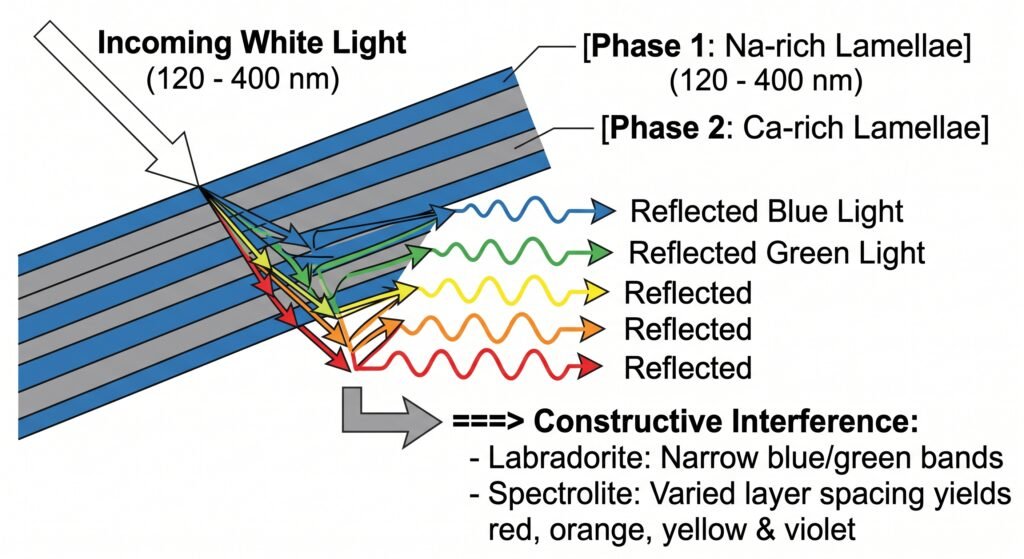
The difference lies in the distribution and regularity of lamellar thickness:
- Standard Labradorite: The exsolution lamellae tend to be uniform in thickness across wide zones, typically spaced to constructively interfere with light waves measuring between 400 and 520 nanometres. This is why the dominant colours seen in Madagascar or Canadian rough are electric blue, teal, and lime green.
- Spectrolite: The crystallisation kinetics within the Ylämaa intrusive complex produced exsolution lamellae of variable, highly controlled thicknesses within single crystal domains. Thicker lamellae ($>250–350\text{ nm}$) constructively amplify the longer wavelengths of visible light—yielding warm coppers, fiery oranges, and deep ruby reds. Thinner zones produce rich magentas and royal purples, often side-by-side with electric blues within the same square centimetre.
Value, Grading & Market Pricing Comparison
Because of its scarcity and optical dominance, authentic spectrolite commands prices far exceeding commercial labradorite.
Market Valuation Matrix (Per Gram / Per Carat)
- Commercial-Grade Labradorite (Madagascar/India):
- Raw rough: £10 – £40 per kilogram.
- Finished cabochons: £0.30 – £2.00 per gram (£0.06 – £0.40 per carat).
- Characteristics: Translucent grey body; single- or dual-colour flash (blue/green); noticeable surface-reaching cleavage fissures.
- Select “Sunset” or “Purple” Labradorite (Madagascar):
- Finished cabochons: £3.00 – £8.00 per gram.
- Characteristics: Uncommon violet or peach flash, but resting on a translucent, cloudy grey base rather than black.
- Genuine Finnish Spectrolite (Ylämaa):
- Raw rough: £250 – £1,000+ per kilogram (gem-grade).
- Finished A/AA-Grade cabochons: £10.00 – £45.00+ per gram (£2.00 – £9.00+ per carat).
- Museum/Master-grade pieces: Often sold as individual collector specimens running into hundreds or thousands of pounds based on colour coverage and artistic execution.
Key Value Drivers for Collectors
- Presence of the Warm Spectrum: Red and orange flashes are the rarest optical occurrences in plagioclase feldspars. A stone displaying a clean ribbon of crimson or apricot commands a 300% to 500% premium over a stone displaying only cyan and blue.
- Groundmass Darkness: A truly opaque, velvet-black matrix without milky or pale patches concentrates optical interference, increasing value.
- Flash Coverage (Face-Up Yield): High-grade stones must flash across 90% or more of their polished surface when viewed directly, without requiring extreme viewing angles.
- Cleavage Integrity: Plagioclase feldspar has perfect cleavage along $\{001\}$ and good cleavage along $\{010\}$. Stones cut without fractures or micro-steps across the surface carry substantial value.
How to Spot Misrepresented “Spectrolite”
Because “spectrolite” commands premium prices, fraudulent and misleading listings are widespread. Here is how to verify authenticity:
Check the Base Matrix Transparency
Hold the cabochon over a bright light source (such as a smartphone torch):
- Standard Labradorite: Light easily penetrates the edges or body of the stone, revealing a foggy, translucent grey, brownish-green, or smoky interior.
- Finnish Spectrolite: It is completely opaque. Light cannot pass through the body of the stone due to the dense dispersion of micro-inclusions; the schiller flashes strictly from the front surface and near-surface layers.
Look at the Colour Transitions
- Standard Labradorite: Colors shift gradually across a single family (e.g., cyan blending into royal blue, or chartreuse blending into gold). Warm tones, when present, tend to appear as faint brassy or yellow-bronze tints.
- Finnish Spectrolite: Colour transitions are distinct and sharp, displaying distinct rainbow bands (red, orange, yellow, green, blue, and violet) sitting directly alongside one another in tight, high-contrast zones.
Demand Locality Provenance
Legitimate dealers and lapidaries working with authentic spectrolite will explicitly state Ylämaa, Finland as the origin. If a listing uses vague descriptions such as “African Spectrolite,” “Madagascar Spectrolite,” or “Spectrolite Rainbow Labradorite,” it is standard labradorite marketed with deceptive terminology.
Summary: Which Should You Choose?
- Choose Standard Labradorite if you appreciate subtle, ethereal, oceanic hues, require large display slabs or bookends, or want affordable, durable material for everyday wire-wrapped jewellery and decorative objects.
- Choose Finnish Spectrolite if you are an avid mineral collector, lapidary connoisseur, or bespoke jeweler looking for an investment-grade showpiece featuring sharp optical contrast, rare red-spectrum interference, and documented European provenance.
Spectrolite vs Labradorite Frequently Asked Questions
What is the fundamental difference between spectrolite and Labradorite?
Spectrolite is a strictly defined, high-grade variety of labradorite sourced from Ylämaa in Southeast Finland, displaying an exceptionally vivid, full-spectrum flash on a dense black base. Labradorite is more widely mined in places like Madagascar, Canada, Russia, and Australia and typically shows a pale to translucent grey matrix with blues and greens. All spectrolite is labradorite, but not all labradorite is spectrolite.
Where does spectrolite come from and why is it special?
Spectrolite comes exclusively from the Ylämaa region in the South Karelia area of Finland, where a wartime discovery led to its recognition as a distinct gem-grade variety. It forms on an opaque black host in the Wiborg rapakivi granite massif and is prized for its broad, vivid spectrum of colours and higher lamellar regularity compared with standard labradorite.
What are the geological and petrological differences between standard Labradorite and spectrolite?
Both are plagioclase feldspar in the labradorite–spectrolite range, but standard Labradorite forms in various host rocks with translucent to semi-opaque matrices and narrower colour ranges, while spectrolite forms with ultra-dense, uniform exsolution lamellae in a dense black matrix, producing a broader colour spectrum and higher contrast.
How can you spot misrepresented spectrolite?
Check the base matrix: standard labradorite is translucent while true spectrolite from Finland is completely opaque with front-surface flashes. Look at colour transitions: labradorite shows gradual shifts within a single family, whereas spectrolite displays distinct rainbow bands side by side. Ensure provenance states Ylämaa, Finland, rather than vague regional names.
Which should you aquire for collection or use, spectrolite or Labradorite?
Choose standard Labradorite for subtle hues, larger display pieces, and affordable, durable material suitable for everyday jewellery and decor. SelectFinnish Spectrolite for investment-grade showpieces with sharp optical contrast and documented European provenance, ideal for serious collectors and bespoke jewellery.
Continue exploring our labradorite guide series: Learn xxxxxx
or explore our detailed breakdown of xxxxxxx
These are my personally selected and curated Labradorite products
Products by Category

Labradorite Elephant 1
£20.00
Labradorite Seahorse 1
£25.00
Labradorite Seahorse 2
£20.00